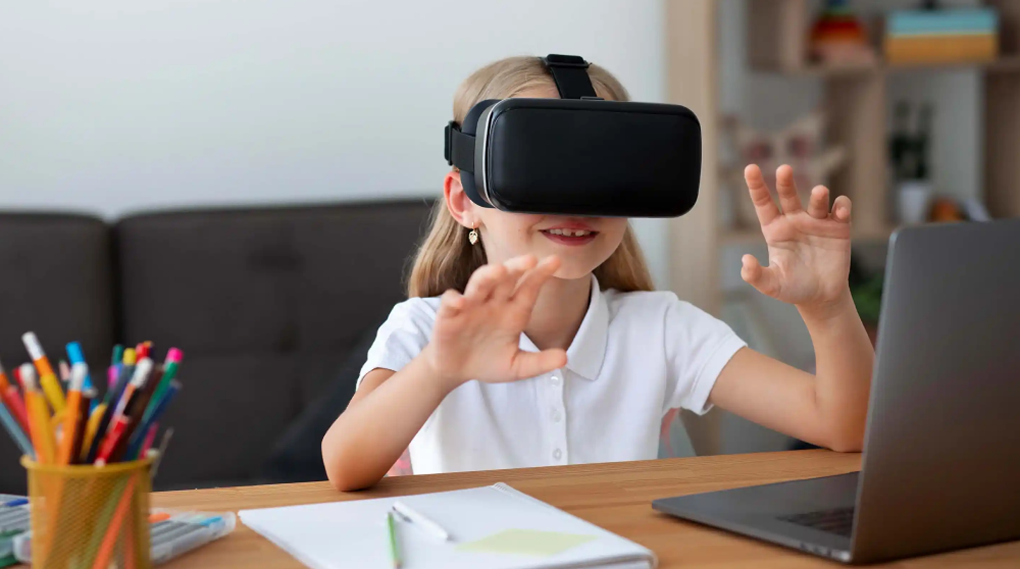
Accessibility and personalization
Another important aspect of using virtual reality in education is its accessibility and the possibility of personalizing the learning process. Virtual reality can be adapted to the needs of each student, offering them different levels of difficulty and approaches to learning depending on their individual needs.
For example, students with different learning speeds can work at their own pace. In a VR biology course, one student can focus on studying the human body, while another can focus on studying plants and their ecosystems. This approach makes learning not only accessible to different categories of students, but also as effective as possible.
In addition, virtual reality allows you to create educational materials that can be used anywhere in the world. This is especially important for people living in remote areas or those who cannot attend educational institutions for physical reasons. The use of VR opens up access to learning to a wide audience, regardless of geographical location or restrictions.
Collaborative and hybrid learning
Virtual reality also has great potential for collaborative learning. It allows you to create virtual classrooms where students can communicate with each other in real time. This opens up opportunities for creating hybrid educational formats where students can learn simultaneously in both physical and virtual spaces.
VR can be used to simulate various social situations in which students work in groups, exchange opinions, solve common problems and learn from each other. This approach supports the development of teamwork, critical thinking and communication skills. In addition, VR technology can be used to create situations in which students have to work with people from different cultures and countries, which is important for the development of global awareness.
Potential for development and application
Virtual reality in education is not just a trend, but a real future that opens up countless opportunities for expanding the horizons of learning. In the future, we can expect the use of VR technologies in a wide range of areas, from language and art teaching to professional courses and training.
Most likely, in the near future in the coming years, virtual reality will become an integral part of educational institutions around the world. This is partly due to technological developments, cheaper equipment, and the increased possibilities for integrating VR into traditional educational processes.
Overcoming limitations
Despite all its advantages, virtual reality in education faces a number of limitations. First, VR equipment can still be expensive, which limits its reach dullness for many educational institutions. Secondly, it is necessary to develop high-quality content that will be as useful and effective as possible for students.
It is also important to take into account that not all students are comfortable using VR devices. Some people may experience headaches, eye strain, or other discomfort when spending a long time in a virtual environment. This requires further development of user interfaces and the duration of VR sessions to minimize such inconveniences.
Conclusion
Virtual reality is already opening up new horizons for education today. Thanks to this, the learning process is more interactive, accessible, and fun. VR creates new opportunities for students and teachers, overcoming many limitations of traditional education. In the future, we can expect that virtual reality will become an integral part of educational institutions, and new technologies will be actively introduced into the learning process, making it more personalized and accessible.
Advertising